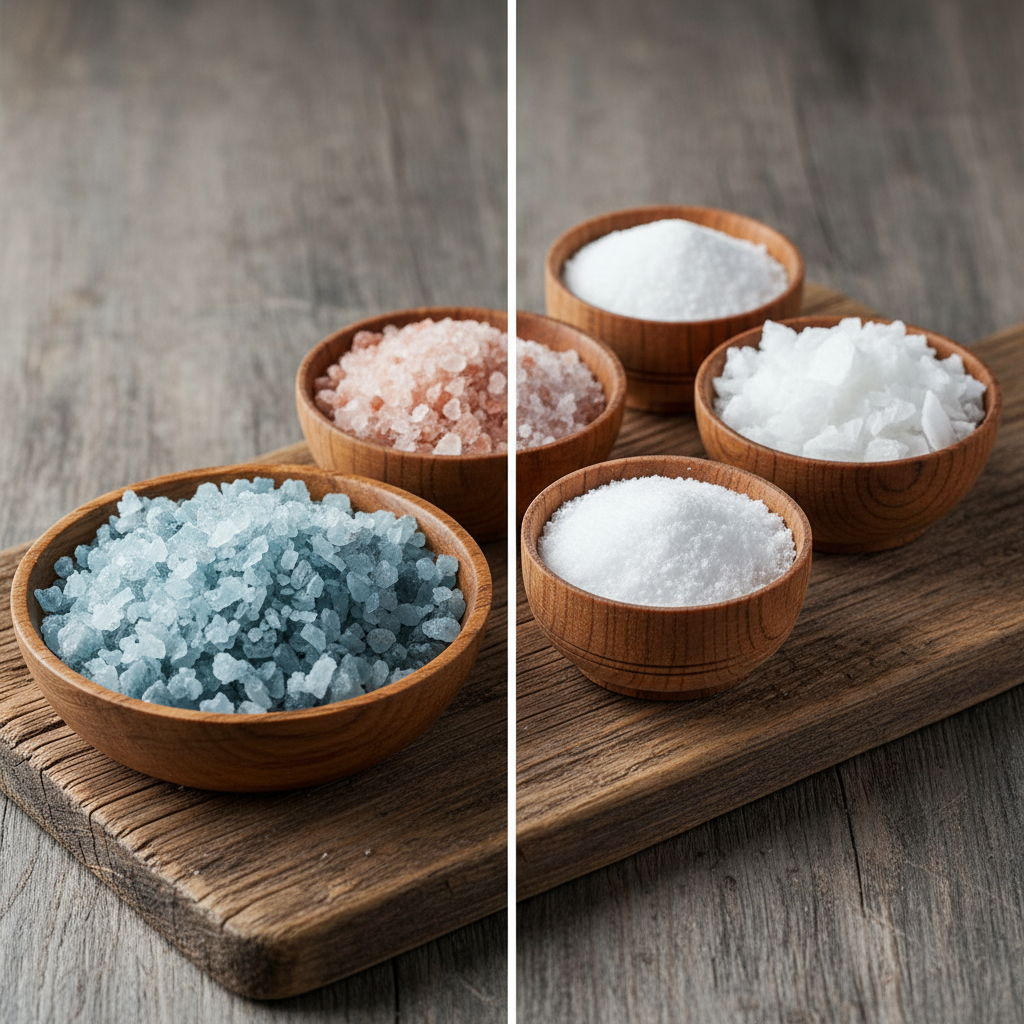
Why Salt Processing Matters — The Case for Unrefined Salt
Walk into any supermarket and you will find dozens of products labeled "salt." Some are white and perfectly uniform; others are pink, grey, or off-white with irregular crystals. The price range can vary by a factor of twenty or more. Understanding why requires understanding what happens between the ocean and the salt shaker — specifically, what industrial processing does to salt and what it removes.
All salt originates from the sea, whether directly from present-day oceans, from ancient evaporated inland seas now found underground, or from modern solar evaporation facilities. The difference between salts lies entirely in what happens after extraction. Refined salt undergoes a series of industrial processes: washing with chemicals to remove impurities, heating at high temperatures to drive off moisture, mechanical grinding to achieve uniform crystal size, and the addition of anti-caking agents to ensure the final product flows freely from a shaker. The result is a product that is 99%+ pure sodium chloride — arguably the most chemically pure food additive in the modern diet.
What is lost in this process is the entire natural mineral matrix that accompanied the sodium chloride in its original seawater context. Magnesium, calcium, potassium, iron, zinc, and over seventy trace minerals are removed or destroyed. Anti-caking agents — compounds like sodium ferrocyanide, magnesium carbonate, or silicon dioxide — are added to compensate for the loss of natural structure. The result functions as a seasoning, but it is a profoundly reduced version of what salt originally was.
Unrefined salts like Celtic grey salt from Guérande preserve the full mineral spectrum through minimal processing: natural evaporation, hand harvesting, and simple drying without heat treatment. They cost more, taste more complex, and require slightly more care in storage — but they deliver a fundamentally different product. The comparison that follows covers the six most common salt types and gives you a clear framework for understanding when each is the right choice.
Celtic Salt vs Table Salt — Complete Comparison
The most fundamental comparison in the salt world. Celtic grey salt and refined table salt appear superficially similar — both are white-to-grey crystalline products used for seasoning — but they are about as different as two products with the same basic function can be.
| Property | Celtic Grey Salt | Refined Table Salt |
|---|---|---|
| Origin | Atlantic seawater, Guérande, Brittany, France | Underground deposits or evaporated brine, worldwide |
| Processing | Hand-harvested, air-dried, unrefined | Heated, chemically washed, mechanically ground |
| Mineral content | 80+ trace minerals retained | 99%+ pure sodium chloride |
| Sodium % | ~33% | ~39% |
| Additives | None | Anti-caking agents, sometimes artificial iodine |
| Color | Grey | Pure white |
| Texture | Moist, irregular crystals | Dry, perfectly uniform |
| Best use | All cooking, brining, finishing, wellness | General cooking, baking where precision needed |
| Price range | $40–100 / 500g | $1–3 / 500g |
The taste difference is immediately apparent: Celtic salt delivers a rounder, more complex saltiness with mineral depth, while table salt provides a sharp, flat, one-dimensional sodium hit. In blind taste tests conducted by culinary schools and food publications, experienced tasters consistently identify Celtic salt as producing more nuanced, satisfying flavors in finished dishes — often requiring less salt to achieve the same perceived saltiness.
From a nutritional standpoint, the lower sodium percentage in Celtic salt (~33% vs ~39%) means you consume roughly 15% less sodium per gram of seasoning used. Combined with the presence of complementary minerals like magnesium and potassium, which have different physiological roles from sodium, Celtic salt represents a meaningfully different nutritional input — not just a more expensive version of the same thing.
Celtic Salt vs Himalayan Salt — Which Is Better?
This is the comparison most frequently searched online, and for good reason: both are premium unrefined salts positioned as superior to table salt, both are widely available, and both occupy similar price points. The reality is that they are very different products suited to different purposes.
| Property | Celtic Grey Salt | Himalayan Pink Salt |
|---|---|---|
| Origin | Guérande, Brittany, France — Atlantic coast | Khewra Mine, Punjab, Pakistan |
| Age | Freshly harvested, current season | Ancient geological deposit, 250+ million years old |
| Color | Grey (mineral clay) | Pink to rose (iron oxide) |
| Texture | Moist, irregular | Dry, consistent |
| Sodium % | ~33% | ~36–38% |
| Key minerals | Magnesium-rich, 80+ minerals from living seawater | Iron-rich (pink color), 84+ minerals from fossil deposit |
| Best for cooking | Brining, fermentation, morning protocol, everyday use | Dry applications, grinding, visual presentation |
| Certification | IGP Guérande (European quality designation) | No equivalent certification standard |
The central distinction is provenance and mineral source. Celtic salt comes from living Atlantic seawater, harvested annually by hand. Himalayan salt is a fossil product: an ancient inland sea evaporated 250 million years ago, the remaining mineral deposit was compressed into rock by geological forces, and it is now mined from deep underground. Neither origin is inherently superior, but they produce genuinely different mineral profiles. Celtic salt tends to be higher in magnesium — often 2–4 times the magnesium content of Himalayan salt — while Himalayan salt is notably higher in iron, which accounts for its distinctive pink color.
Experience the difference: Discover Authentic Celtic Grey Salt →
For culinary use, the moisture content of Celtic salt makes it better suited to wet applications: brining poultry and pork, lacto-fermentation, pickling, and dissolving in water for the morning protocol. Himalayan salt's dry, uniform crystals make it easier to use in salt mills and grinders, and its pink color makes it visually attractive for table presentation. See our complete Celtic salt guide for full context on how each salt type performs across cooking applications.
Celtic Salt vs Kosher Salt — The Chef's Perspective
Kosher salt is the workhorse of professional kitchens. Its large, flat flakes dissolve quickly, cling to food surfaces effectively, and — crucially — contain no iodine, which can add a metallic taste to certain preparations. Understanding how it compares to Celtic salt matters for both home cooks and professionals.
| Property | Celtic Grey Salt | Kosher Salt |
|---|---|---|
| Processing | Unrefined, hand-harvested | Typically refined, mechanically processed |
| Crystal shape | Irregular, chunky | Large, flat flakes (pyramid-shaped) |
| Mineral content | 80+ minerals | Near-pure sodium chloride |
| Iodine | Natural trace amounts from seawater | Typically none added |
| Texture | Moist | Dry |
| Best use | All applications including fermentation | Meat preparation, quick seasoning, pasta water |
The key advantage of kosher salt in professional kitchens is tactile: the large, flat flakes are easy to pinch and sprinkle evenly, giving chefs precise manual control over seasoning. The flat crystal structure also means kosher salt adheres well to meat surfaces for dry-brining and curing applications. Most kosher salt, however, is refined — it contains no trace minerals and is essentially pure sodium chloride in a different physical form than table salt.
Celtic coarse salt can substitute for kosher salt in most applications, with some adjustment for the moisture content and the slightly denser, chunkier crystal structure. For fermentation, Celtic salt is actually preferable to kosher salt because its natural mineral content supports beneficial bacterial activity, whereas some kosher salts contain residual additives that can inhibit fermentation cultures. The absence of iodine in most kosher salts (and the only natural trace iodine in Celtic salt) makes both suitable for preserving and fermenting.
Celtic Salt vs Fleur de Sel — Two Siblings from Guérande
This comparison is unique because both salts come from exactly the same location — the salt pans of Guérande — harvested by the same paludiers using the same traditional methods. The difference is where within the salt pan each is collected.
| Property | Celtic Grey Salt (Gros Sel) | Fleur de Sel |
|---|---|---|
| Harvest position | Bottom of salt pan (clay contact) | Surface of salt pan (floating crystals) |
| Color | Grey | White to very light grey |
| Crystal size | Medium to coarse, chunky | Delicate, thin, irregular flakes |
| Texture | Moist, clumping | Very lightly moist, delicate |
| Mineral content | Higher (clay mineral absorption) | Lower (no clay contact) |
| Best use | Cooking, brining, everyday seasoning | Finishing only — added at the table |
| Price | Mid-range | Premium (3–5x the cost of grey salt) |
Fleur de sel forms when the conditions in the salt pan are exactly right: calm winds, strong sun, and low humidity allow a delicate crust of salt crystals to form on the water's surface. Paludiers harvest this with a special skimmer, working quickly before the crystals sink. The yield is tiny compared to grey salt — perhaps 5% of the volume — which explains the premium price.
The practical distinction is clear: Celtic grey salt is for cooking, fleur de sel is for finishing. Adding fleur de sel to a boiling pot of pasta would be a waste of its delicate texture and premium price. Conversely, grey salt used as a finishing salt on a piece of grilled fish lacks the visual appeal and textural interest of fleur de sel's light, crunchy flakes. Used correctly, both are excellent. See our complete fleur de sel guide for more detail on this premium salt.
Celtic Salt vs Generic Sea Salt — Not All Sea Salts Are Equal
"Sea salt" is perhaps the most misleading term in the food industry. It conveys images of ocean waves, natural purity, and artisan production — but carries no regulatory definition in most markets. A manufacturer can label a heavily refined, bleached, additive-containing salt as "sea salt" simply because it originated from ocean water at some point in the production process. Understanding this distinction is essential before reaching for a "sea salt" product in the belief that it differs meaningfully from table salt.
The vast majority of products sold as "sea salt" in mainstream supermarkets are industrially refined to approximately the same purity as table salt — 99%+ sodium chloride with trace minerals removed and anti-caking agents added. The only genuine difference from conventional table salt may be slightly larger crystal size, a coarser texture, or a light grey or beige tint — cosmetic differences that have no nutritional significance.
Authentic unrefined sea salts like Celtic grey salt are distinguished by specific characteristics that cannot be faked: natural moisture, grey or pink color from mineral contact, irregular crystal structure, and a traceable geographic origin with a protected designation. When evaluating any "sea salt" product, look for explicit statements of "unrefined" on the label, IGP or similar protected origin certification, and a color and texture consistent with minimal processing. White, dry, free-flowing "sea salt" in a paper tube is almost certainly industrially refined regardless of the waves on the packaging.
IGP certified · Hand-harvested · 80+ trace minerals
Celtic Grey Salt — 500g / 17.6 oz · $79.99
Order Now — Free Shipping over $75 →Celtic Salt vs Rock Salt — Origin and Mineral Profile
Rock salt — also known as halite — is salt extracted directly from underground mineral deposits formed when ancient seas evaporated millions of years ago. It is found on every continent and mined in enormous quantities for industrial use (road de-icing, water softening, chemical production) as well as food-grade applications. Himalayan pink salt is a specific, well-known variety of food-grade rock salt; other varieties include Polish Wieliczka salt, Bolivian rose salt, and common grey rock salt.
Compared to Celtic salt, rock salt has a fundamentally different mineral profile. Without the ongoing enrichment from living seawater, rock salt's mineral content reflects the ancient sea composition and subsequent geological history of its specific deposit. Some rock salts are relatively pure sodium chloride with minimal trace minerals; others — like Himalayan salt — have notable iron content. None have the specific mineral balance of fresh Atlantic seawater combined with Guérande clay that characterizes authentic Celtic salt.
For culinary use, rock salts are typically drier and harder than Celtic salt, making them easier to grind in salt mills. They lack the moisture-dependent behavior that makes Celtic grey salt particularly effective for brining and fermentation. Rock salt is the right choice when you want consistent, dry crystals for grinding and precise measurement; Celtic salt is the right choice when mineral complexity, moisture, and the full Atlantic mineral spectrum are priorities.
The Overall Verdict — When to Choose Which Salt
Having compared six salt types across multiple dimensions, a practical use-case guide emerges. The "best" salt depends entirely on what you are trying to achieve.