What Is Celtic Salt? Origin, Definition and What Makes It Unique
Celtic salt is an unrefined, hand-harvested sea salt produced in the salt marshes of Guérande, a coastal region in Brittany, France. Unlike the refined white salts found on most supermarket shelves, Celtic salt retains its natural grey color, slight moisture, and full spectrum of over 80 trace minerals. It is often referred to as "sel gris" in French — literally "grey salt" — and this distinctive color is one of the most reliable indicators of its authenticity.
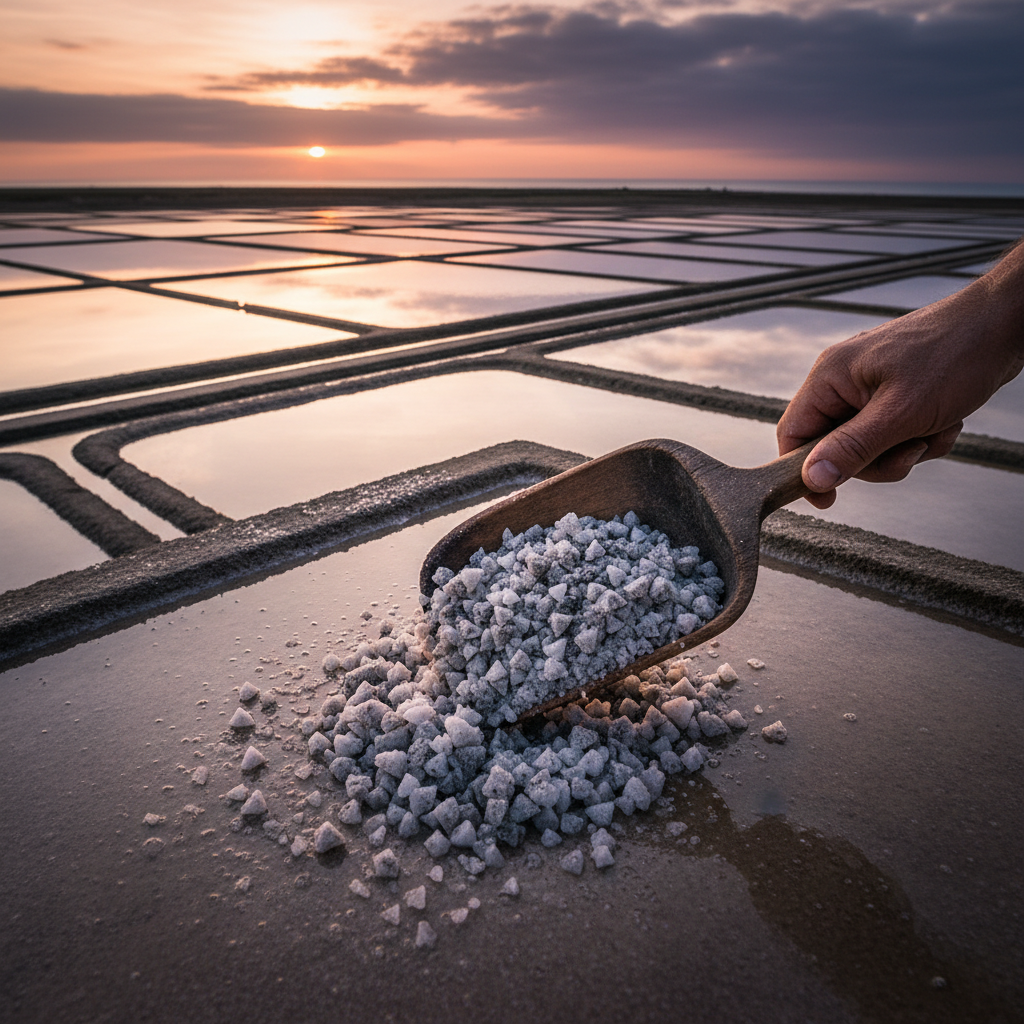
What makes Celtic salt genuinely unique begins with its source. The Guérande salt marshes are a complex ecosystem of interconnected clay-lined ponds called oeillets, where Atlantic seawater slowly evaporates under the influence of sun and wind. The salt crystallizes at the bottom of these ponds, where it comes into contact with the mineral-rich grey clay. This clay interaction is responsible for both the grey color and a significant portion of the mineral content that distinguishes Celtic salt from any other variety.
The harvest process itself is entirely manual. Paludiers — the traditional salt harvesters of Guérande — use long-handled wooden rakes called las to collect the salt crystals from the bottom of the ponds. No machinery touches the salt. No heat processing is used. No additives, anti-caking agents, or bleaching agents are introduced. What leaves the salt marsh is essentially what came from the sea, enriched by the clay and concentrated by evaporation.
Celtic salt carries IGP (Indication Géographique Protégée) certification — a European quality designation similar to the certifications given to Champagne or Parmigiano-Reggiano. This means that only salt produced in the traditional way in the Guérande region can legally carry the Guérande salt designation. This certification is your guarantee of origin and method when purchasing authentic Celtic salt.
The moisture content of Celtic salt is another key characteristic. A good Celtic grey salt should feel slightly damp to the touch — not wet, but never bone dry. This moisture is a natural indicator that the salt has not been heat-treated or refined. Dry, white salt labeled "Celtic" is almost certainly a processed imitation. The authentic product clumps slightly, dissolves more slowly than table salt, and has a complex, mineral-rich taste that professional chefs describe as briny, full, and oceanic.
The 2,000-Year History of Guérande Salt — From Roman Times to Today
The salt marshes of Guérande have been in continuous operation for over two thousand years. Archaeological evidence and historical records confirm that the region was producing salt during the Roman occupation of Gaul, making it one of the oldest continuously operating artisan salt production sites in the world. Roman legions required enormous quantities of salt for food preservation, and Guérande's Atlantic coast location made it an ideal supply point for the entire region.
During the medieval period, Guérande salt became one of the most valuable commodities in Western Europe. Salt was so precious that it was sometimes used as currency — a fact preserved in our language through the word "salary," derived from the Latin salarium, the salt ration given to Roman soldiers. The salt trade from Guérande fueled the economic development of Brittany and established trade networks extending as far as Scandinavia, where Breton salt was used for preserving cod and herring.
The 19th and 20th centuries brought industrialization to the salt industry across most of France, but Guérande remained an exception. The unique geography of the region — the combination of the right clay substrate, Atlantic tidal patterns, and the specific microclimate — meant that mechanization was both technically difficult and economically counterproductive. The traditional paludier craft survived not simply through cultural conservatism, but because the environment genuinely required it.
By the mid-20th century, the number of active paludiers had declined dramatically. Industrial competition, urban migration, and the low economic status of artisan salt work threatened to extinguish the tradition entirely. The revival came from an unexpected direction: the organic food movement and the growing awareness among chefs and nutritionists of the qualitative differences between refined and unrefined salts. By the 1980s and 1990s, Guérande salt had been rediscovered as a premium product, and demand began to outpace supply.
Today the Guérande salt marshes cover approximately 2,000 hectares and support around 200 active paludier families. The marshes were classified as a UNESCO biosphere reserve, recognizing both their ecological importance and their cultural heritage. The paludier craft is now formally classified as part of France's intangible cultural heritage. Far from disappearing, the tradition has been strengthened by the premium market for authentic artisan salt — and by the recognition that no industrial process can replicate what the tides, the clay, and the skilled hands of a paludier produce.
Celtic Salt vs Table Salt — The 7 Key Differences
The differences between Celtic grey salt and refined table salt go far beyond simple taste preferences. They represent fundamentally different products, produced by completely different methods, with substantially different compositions.
| Property | Celtic Grey Salt | Refined Table Salt |
|---|---|---|
| Processing | Hand-harvested, unrefined, no additives | Heavily refined, bleached, anti-caking agents added |
| Mineral content | 80+ trace minerals retained | 99%+ sodium chloride, minerals stripped |
| Sodium % | ~33% sodium (lower) | ~39% sodium (higher) |
| Additives | None | Anti-caking agents (E535, E536), sometimes iodine |
| Color | Grey (from clay minerals) | Pure white (bleached) |
| Texture | Moist, irregular crystals | Dry, uniform fine crystals |
| Taste | Complex, mineral-rich, briny | Sharp, flat, purely salty |
The processing difference is the most fundamental. Table salt is typically mined from underground deposits or produced by evaporating brine in industrial facilities, then subjected to intense heat processing, chemical washing, and mechanical refinement. This removes virtually all minerals except sodium chloride. Anti-caking agents such as sodium ferrocyanide or magnesium carbonate are then added to prevent clumping. The result is a chemically pure product — but one stripped of everything the sea originally put into it.
Experience the difference: Discover Authentic Celtic Grey Salt →
Celtic salt, by contrast, undergoes no such processing. The mineral content it retains is not "added back" — it was never removed in the first place. The lower sodium percentage in Celtic salt compared to table salt means that, gram for gram, Celtic salt delivers less sodium while providing a broader range of complementary minerals. The balance of minerals in natural salt — sodium alongside potassium, magnesium, and calcium — more closely mirrors the mineral profile found in human blood plasma than pure sodium chloride alone.
The taste difference is immediately apparent to most people who make the switch. The complex mineral content of Celtic salt creates a rounder, more full-flavored saltiness that many chefs prefer precisely because it enhances food without the sharp, one-dimensional edge that refined salt can produce. Less salt is often needed to achieve the desired seasoning effect.
Celtic Salt vs Himalayan Salt — A Complete Side-by-Side Comparison
Both Celtic grey salt and Himalayan pink salt occupy the premium, unrefined salt category. They do, however, have genuinely different origins, mineral profiles, textures, and best-use applications.
| Property | Celtic Grey Salt | Himalayan Pink Salt |
|---|---|---|
| Origin | Guérande, Brittany, France | Khewra Mine, Punjab, Pakistan |
| Formation | Active seawater evaporation | Ancient geological deposit |
| Color | Grey (clay minerals) | Pink (iron oxide) |
| Texture | Moist, slightly clumping | Dry, consistent crystals |
| Sodium % | ~33% | ~36–38% |
| Harvest | Hand-raked by paludiers annually | Mined from underground deposits |
The most important distinction is provenance. Celtic salt comes from living seawater — harvested fresh each season from the Atlantic. Himalayan salt is a fossil product, formed from an ancient inland sea that evaporated hundreds of millions of years ago. For cooking, Celtic salt's moisture makes it preferable for brining, pickling, and fermentation. Himalayan salt's dry, granular texture makes it easier to grind precisely. See our full celtic salt vs himalayan salt comparison for an in-depth analysis.
The 80+ Minerals Found in Celtic Grey Salt — What They Do
Authentic Celtic salt retains the full mineral spectrum present in Atlantic seawater — concentrated and enriched by the clay of the Guérande salt pans. Analysis consistently identifies over 80 distinct mineral and trace mineral elements.
Magnesium is present at 0.1–0.6% by weight — significantly higher than most other salts. Magnesium participates in over 300 enzymatic reactions: muscle function, protein synthesis, blood sugar regulation, and nerve transmission. Calcium contributes to bone structure and muscle contraction. Potassium works with sodium to regulate fluid balance and cellular electrical gradients. Iron supports oxygen transport. Zinc plays a role in immune function and wound healing. Iodine, present naturally from seawater, supports thyroid function.
Beyond these, Celtic salt contains trace elements — manganese, selenium, chromium, silicon — in the minute concentrations that occur naturally in seawater. The mineral matrix in unrefined sea salt more closely mirrors the composition of human blood plasma than any refined alternative, a fact that has supported centuries of traditional use. It is important to note that Celtic salt is a condiment, not a supplement: its value lies in the cumulative daily contribution it makes as part of a balanced diet.
How to Use Celtic Salt in Cooking — The Complete Guide
Celtic salt is available in three main forms: coarse grey salt (gros sel), fine grey salt (sel fin), and fleur de sel. Each has different culinary applications.
Coarse Celtic grey salt is the workhorse. Its large crystals dissolve slowly, making it ideal for brining meat (1 tablespoon per litre of water for 4–24 hours), pasta water (a generous handful per large pot), and bread making. For fermentation projects — kimchi, sauerkraut, lacto-fermented pickles — coarse Celtic salt is preferable to iodized table salt, as iodine can interfere with beneficial bacterial cultures.
Fine Celtic grey salt is the everyday seasoning choice. It substitutes 1:1 for table salt in most recipes. Use it for seasoning vegetables before roasting, finishing scrambled eggs, salad dressings, sauces, and dry rubs for grilling. Fleur de sel, harvested from the surface of the salt pans, is lighter and more delicate — a finishing salt for raw fish, sliced tomatoes, dark chocolate, and premium salads. See our fleur de sel complete guide for more.
Storage: keep Celtic salt in a ceramic or glass container with a loose-fitting lid. The natural moisture means it can clump over time — this is normal, not spoilage. A small piece of dry bread in the container helps manage humidity in damp environments.
IGP certified · Hand-harvested · 80+ trace minerals
Celtic Grey Salt — 500g / 17.6 oz · $79.99
Order Now — Free Shipping over $75 →Celtic Salt for Hydration — The Morning Protocol and Electrolytes
One of the most discussed applications of Celtic salt in contemporary wellness culture is its use in hydration protocols — particularly dissolving a small amount of fine Celtic salt in water and consuming it first thing in the morning. For the complete protocol, see our Celtic salt morning protocol guide.
The rationale is physiological: during sleep, the body uses electrolytes for cellular repair and hormone regulation. After 7–9 hours, the body wakes in mild electrolyte depletion. Plain water alone dilutes remaining electrolytes further. Adding Celtic salt — rich in sodium, magnesium, and dozens of other minerals — provides an immediate electrolyte boost that many people find supports morning energy and digestion.
Athletes use it strategically around training: Celtic salt water before exercise may support performance, and post-workout helps replenish electrolytes lost through sweat. The standard morning protocol: ¼ to ½ teaspoon of fine Celtic salt dissolved in 250–500ml of room-temperature water, consumed before coffee or food. Many add fresh lemon juice for palatability. See our guide to Celtic salt and electrolytes for the science.
How to Identify and Choose Authentic Celtic Salt
The premium salt market has attracted products using the "Celtic salt" label without meeting the standards of the genuine article. Three indicators reliably distinguish authentic Celtic grey salt from imitations.
Color: Authentic Celtic grey salt is distinctly grey. The grey color from mineral-laden clay cannot be replicated without additives. White or barely-grey "Celtic salt" has been processed, removing the clay minerals. Trust the grey. Moisture: Run it between your fingers — it should feel slightly damp and clump lightly. Bone-dry Celtic salt has been heat-treated. Natural moisture is preserved only in unrefined salt. IGP Guérande certification: Look for this on the label. It is a legally regulated European designation guaranteeing origin and method — not simply a marketing claim.
For format: coarse grey salt for brining and cooking, fine grey salt for everyday seasoning, fleur de sel for finishing. Buying the right format for your primary use maximizes culinary value. Our authentic Celtic grey salt is IGP-certified, hand-harvested, and imported directly from Guérande.
Celtic Salt for Skin and Body — Traditional Wellness Uses
Beyond the kitchen, Celtic grey salt has a long tradition in personal care and wellness. These are traditional practices — not medical treatments — and should be understood as complementary lifestyle choices. See our complete guide to Celtic salt for skin.
Celtic salt baths: Adding 250–500g of coarse Celtic salt to a warm bath creates a mineral-rich soak that many people find deeply relaxing. Popular among athletes for post-training recovery and among those with dry or sensitive skin. Water should be warm but not hot; soak for 20–30 minutes. Salt scrubs: Combine fine Celtic salt with a carrier oil (coconut, jojoba, or sweet almond) for a natural exfoliating scrub. Apply to damp skin in gentle circular motions, avoiding the face and broken skin, then rinse thoroughly. Saline nasal rinses: Celtic salt dissolved in sterile water (¼ teaspoon per 250ml distilled water) is used for nasal hygiene. The absence of additives makes it preferable to iodized table salt for this application.
Frequently Asked Questions About Celtic Salt
Is Celtic salt actually better than table salt?
Celtic salt and table salt serve the same basic culinary function but differ significantly in composition and processing. Celtic salt retains over 80 trace minerals that refined table salt has had removed, contains no additives or anti-caking agents, and has a lower sodium percentage per gram. For people who want a minimally processed, additive-free salt with a richer mineral profile, Celtic salt is a meaningfully different product. Whether that makes it "better" depends on your priorities — culinary, nutritional, or ethical.