Hand-harvested Guérande salt · Tracked international delivery included
Guide· by Celtic Salt Editorial Team
How Many Minerals Does Celtic Salt Have
What Is How Many Minerals Does Celtic Salt Have and Why It Matters in 2026
Celtic salt — harvested by hand from the ancient tidal clay ponds of Guérande in Brittany, France — is one of the most mineral-dense natural salts available anywhere in the world. Unlike highly processed table salt, which is stripped of virtually everything except sodium chloride, authentic Celtic grey salt retains the full spectrum of naturally occurring trace minerals and macro-minerals that were present in the pristine Atlantic seawater from which it was born. The question "how many minerals does Celtic salt have?" is not merely a curious nutritional footnote — it is the very heart of what makes this ancient salt so different from the cheap, bleached, industrially refined alternatives that fill supermarket shelves today. In 2026, as consumers become increasingly sophisticated about the foods they eat, the minerals in their salt, and the provenance of their ingredients, understanding the complete mineral profile of Celtic grey salt has become more important than ever before.
Scientific analysis of authentic Guérande Celtic grey salt consistently identifies over trace minerals whose levels vary by harvest and product and elements within its crystalline structure. This extraordinary mineral density is the direct result of the traditional paludier harvesting method — a craft passed down through generations of Breton salt farmers who work with the tides, the wind, and the sun rather than against them. As Atlantic seawater flows into the carefully designed clay basins known as oeillets, it undergoes a slow, natural evaporation process that concentrates not just sodium and chloride but the entire orchestra of minerals present in the ocean. The grey colour that gives this salt its distinctive visual identity comes from the mineral-rich clay of the Guérande basin itself, and that clay contributes additional trace elements that simply cannot be found in salts harvested from other geographical regions. This is what the French call terroir — the unique environmental fingerprint of a specific place — and it translates directly into every crystal of Celtic grey salt.
The growing interest in Celtic salt's mineral content in 2026 is closely tied to broader shifts in how people think about nutrition, hydration, and electrolyte balance. Mainstream dietary advice for decades focused almost exclusively on reducing sodium intake, often without acknowledging that sodium in isolation behaves very differently in the body than sodium in the presence of magnesium, potassium, calcium, and dozens of other co-factors. Research from the fields of nutritional biochemistry and sports physiology has increasingly highlighted the role of trace minerals in cellular hydration, nerve conductance, enzyme activation, and metabolic regulation. When people ask how many minerals Celtic salt contains, they are often really asking whether this salt can help them achieve better mineral balance — and the honest, evidence-supported answer is that the mineral richness of authentic Celtic grey salt makes it a fundamentally different food product from standard refined salt. That difference is measurable, verifiable, and genuinely meaningful for everyday health and culinary practice.
It is also worth noting that not all salts marketed as "Celtic" or "grey salt" deliver the same mineral profile. The authenticity of the source matters enormously. True Guérande Celtic grey salt, particularly when it carries the Label Rouge certification or the Indication Géographique Protégée (IGP) designation, has been independently verified to meet strict standards of production and mineral content. Counterfeit or low-quality imitations may be dyed grey, processed with additives, or sourced from polluted waters — meaning their mineral content is either absent or potentially harmful. As we move deeper into an era where food transparency and traceability are consumer expectations rather than luxuries, understanding how many minerals authentic Celtic salt contains — and why that number matters — becomes a form of informed self-advocacy. This comprehensive guide will walk you through everything you need to know about the mineral profile of Celtic grey salt, from the science to the kitchen.
The Complete Guide to How Many Minerals Does Celtic Salt Have
The short answer to "how many minerals does Celtic salt have?" is: over trace minerals whose levels vary by harvest and product and elements. But the more meaningful answer requires understanding which minerals are present, in what quantities, and what roles they play in the broader context of nutrition and flavour. Celtic grey salt's mineral profile is typically divided into two categories: macro-minerals (present in relatively larger amounts) and trace minerals (present in smaller but biologically significant amounts). Both categories contribute to the salt's character, and both are absent or severely depleted in commercially refined table salt.
The dominant macro-minerals in Celtic grey salt include sodium, chloride, magnesium, calcium, potassium, and sulphur. Sodium and chloride together form the bulk of the salt — approximately 82–84% of its composition — but this percentage is notably lower than in refined table salt, which is typically 97–99% sodium chloride. This lower sodium chloride ratio is significant because it means Celtic grey salt delivers proportionally more of the complementary minerals per gram consumed. Magnesium is one of the most celebrated components of Celtic grey salt, present in levels that are genuinely meaningful from a nutritional standpoint. Magnesium participates in over 300 enzymatic reactions in the human body and is chronically under-consumed in modern Western diets. The fact that authentic Celtic grey salt provides a dietary source of this critical mineral is one of the reasons it has earned such enthusiastic endorsement from nutritionists, integrative health practitioners, and culinary professionals alike.
Calcium in Celtic grey salt supports bone health, muscle contraction, and cardiovascular function. Potassium acts as sodium's essential counterpart in maintaining healthy fluid balance within and outside of cells — a relationship that is fundamentally disrupted when you consume refined salt with virtually no potassium present. Sulphur, while less glamorous than some of the other minerals, plays vital roles in protein synthesis, detoxification pathways, and connective tissue formation. These macro-minerals alone would make Celtic grey salt a nutritionally superior choice to refined alternatives, but they are only part of the story.
The trace mineral profile of Celtic grey salt reads like a comprehensive survey of the ocean's chemistry. Iron, zinc, selenium, manganese, copper, iodine, chromium, molybdenum, silicon, boron, lithium, rubidium, cobalt, vanadium, strontium, and fluoride are among the many trace elements that have been identified through independent laboratory analysis of authentic Guérande salt. Each of these elements has known biological functions in human physiology. Zinc is essential for immune function, wound healing, and DNA synthesis. Selenium acts as a powerful antioxidant co-factor. Iodine — naturally occurring in Celtic salt, though in modest amounts — supports thyroid function. Manganese is critical for antioxidant defence and bone formation. These trace minerals are present in amounts that, while small, contribute to a more complete nutritional picture than any refined salt can offer.
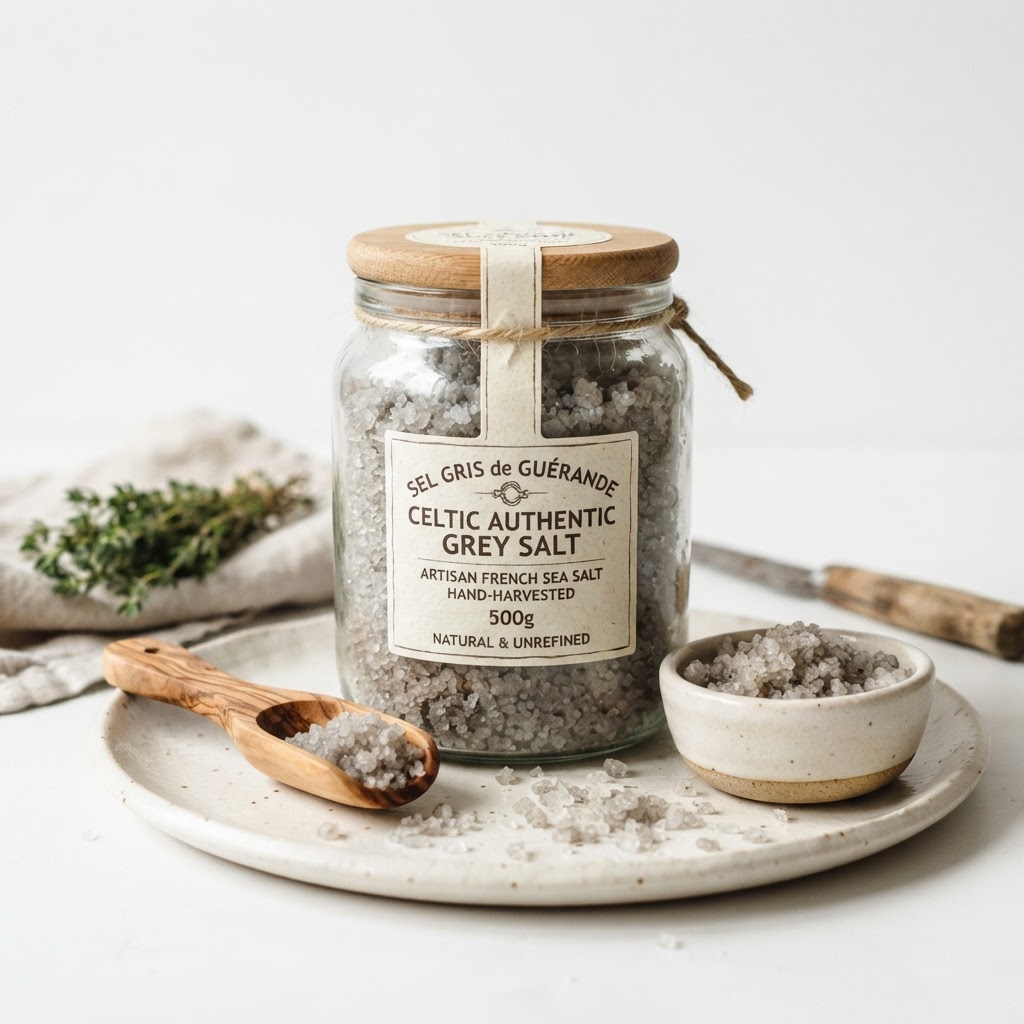
The moisture content of Celtic grey salt also deserves mention in any complete mineral discussion. Authentic Celtic grey salt is slightly moist to the touch — a characteristic that surprises first-time users accustomed to free-flowing table salt. This natural moisture is actually a mineralised brine, rich in magnesium chloride (the same compound found in the mineral nigari used in tofu production). This brine is not a flaw or a quality defect; it is evidence of the salt's authenticity and a direct carrier of its most abundant trace minerals. Artificially dried or heated grey salts lose this brine and with it, a significant portion of their magnesium and other water-soluble mineral content. When you handle real Celtic grey salt and feel its characteristic slight dampness, you are touching the mineral wealth of the Atlantic Ocean in concentrated form.
For a clear overview of the primary minerals found in authentic Celtic grey salt, consider the following approximate composition based on published laboratory analyses:
Sodium chloride accounts for approximately 82–84% of the total mineral content. Magnesium is present at levels ranging from 0.1% to 0.4% depending on specific harvest conditions and location within the Guérande basin. Calcium typically appears at 0.05% to 0.2%. Potassium is found at approximately 0.05% to 0.15%. Sulphur contributes trace amounts typically below 0.1%. The remaining 80-plus trace elements collectively account for a small but analytically verified fraction of the total composition. These numbers may seem modest in percentage terms, but they represent a genuinely significant improvement over refined salt, which contains essentially zero of these co-minerals.
Health and Culinary Benefits of Celtic Salt's Rich Mineral Profile
The health and culinary benefits of Celtic grey salt flow directly from its exceptional mineral density, and understanding these benefits requires approaching the topic honestly — neither dismissing real nutritional advantages nor overclaiming medical cures that no salt can provide. What the science does support, clearly and consistently, is that the trace mineral profile of authentic Celtic grey salt makes it a more nutritionally complete food ingredient than refined alternatives, and that this difference has practical implications for how your body processes it, how your food tastes, and how your overall dietary mineral intake balances out over time.
From a culinary perspective, the mineral complexity of Celtic grey salt translates directly into flavour depth that chefs and serious home cooks immediately recognise. Refined table salt delivers a sharp, one-dimensional saltiness that can easily tip into harshness if used too liberally. Celtic grey salt, by contrast, delivers a rounded, multi-layered saltiness — sometimes described as briny, oceanic, or subtly sweet — that enhances food rather than simply making it salty. This flavour complexity is the direct taste expression of those 80-plus minerals interacting with food's proteins, fats, carbohydrates, and volatile aromatic compounds. The magnesium content, in particular, is believed to contribute a subtle mineral sweetness that balances the sharpness of sodium chloride. Professional chefs working in top restaurants across France, the United Kingdom, the United States, and beyond regularly specify Guérande grey salt precisely because of this flavour superiority.
The hydration and electrolyte benefits of Celtic grey salt are supported by an emerging body of research on mineral co-factors in cellular hydration. Electrolyte balance — the proper ratio of sodium, potassium, magnesium, and chloride inside and outside of cells — is fundamental to every physical process the body performs, from muscle contraction to cognitive function to cardiovascular rhythm. When you consume sodium without its natural mineral companions, as happens with refined salt, the body must work harder to re-establish electrolyte equilibrium, often at the cost of drawing on mineral reserves stored in bone and tissue. Celtic grey salt, with its naturally balanced mineral matrix, provides sodium alongside the complementary electrolytes that help the body use it more efficiently. Athletes, active individuals, and anyone who sweats heavily have particular reason to value this more complete electrolyte profile.
The magnesium content of Celtic grey salt deserves particular attention given magnesium's status as one of the most widespread nutritional deficiencies in the modern world. Population studies consistently find that large proportions of adults in developed countries consume less magnesium than recommended daily intake guidelines suggest. Magnesium participates in energy production, protein synthesis, muscle and nerve function, blood glucose regulation, and blood pressure maintenance. While Celtic grey salt alone cannot correct a significant magnesium deficiency, substituting it for refined table salt in daily cooking represents a meaningful incremental improvement in dietary magnesium intake. Every pinch of Celtic grey salt used in cooking or at the table adds a small but real contribution to the day's mineral intake — a form of nutritional fortification that requires no supplements, no pills, and no behavioural change beyond using a better quality salt.
How to Use Celtic Salt's Mineral Richness — Expert Tips
Using Celtic grey salt well is partly about knowing when its mineral complexity will shine brightest and partly about understanding its physical properties — particularly its slightly larger grain size and natural moisture content. Unlike fine table salt, which dissolves almost instantly and distributes evenly through food, Celtic grey salt has a more variable crystal size and a satisfying crunchy texture when used as a finishing salt. Knowing how to deploy these characteristics strategically allows you to extract maximum flavour and mineral benefit from every use.