Hand-harvested Guérande salt · Tracked international delivery included
Guide· by Celtic Salt Editorial Team
Celtic Salt and Thyroid Health: What to Know About Iodine
Food information, not medical advice. Salt remains a significant source of sodium. Trace-mineral levels can vary by harvest and product, and culinary salt should not be used as a treatment or medical electrolyte supplement.
What Is Celtic Salt and Thyroid Health: What to Know About Iodine and Why It Matters in 2026
In an era where chronic health conditions are rising and consumers are scrutinising every ingredient on their labels, the relationship between the salt we use daily and our thyroid health has never been more relevant. Celtic grey salt, hand-harvested from the pristine tidal marshes of Guérande in Brittany, France, occupies a fascinating and often misunderstood position in this conversation. Unlike heavily processed table salt that lines most supermarket shelves, authentic Celtic grey salt retains its natural mineral complexity — a characteristic that has sparked both enthusiasm and legitimate questions among health-conscious individuals worldwide. As we move deeper into 2026, with thyroid disorders affecting an estimated 200 million people globally, understanding the nuanced relationship between artisan sea salt and thyroid function has become genuinely important, not just a wellness trend.
The thyroid gland, a small butterfly-shaped organ sitting at the base of the neck, is responsible for producing hormones that regulate metabolism, energy production, heart rate, body temperature, and even mood. To function properly, the thyroid depends on a steady supply of iodine — a trace mineral that the human body cannot produce on its own. This dependency makes dietary iodine intake critically important, and it is precisely here that the conversation about Celtic salt becomes complex and nuanced. Celtic grey salt is a minimally processed, naturally harvested product that preserves its rich profile of trace minerals including magnesium, calcium, potassium, and many others. However, it is not a significant source of iodine in the way that industrially iodised table salt is designed to be. Understanding this distinction is not a reason to avoid Celtic salt — far from it — but it is knowledge that empowers better dietary decisions.
The widespread addition of iodine to table salt began in the early twentieth century as a public health measure to combat iodine deficiency disorders, including goitre and cretinism, which were endemic in many inland regions far from the sea. This intervention was enormously successful and represents one of the great achievements of nutritional public health. However, in 2026, the dietary landscape has changed dramatically. Many people now consume iodine from a wide variety of sources including seafood, dairy products, eggs, seaweed, and various fortified foods. At the same time, awareness around the health implications of ultra-processed foods — including standard iodised table salt and its additives such as anti-caking agents and bleaching chemicals — has grown significantly. This creates a space where natural, mineral-rich alternatives like authentic Celtic grey salt from Guérande can be valued for what they genuinely offer, while still allowing for informed decisions about overall iodine intake.
What makes this topic particularly timely in 2026 is the surge of interest in ancestral diets, functional nutrition, and whole-food approaches to health. Celtic grey salt has been produced using essentially the same traditional methods for over a thousand years, and its advocates point to its unprocessed nature and rich mineral content as benefits that go well beyond simple sodium chloride delivery. The paludiers — the salt farmers of Guérande — harvest their product by hand using wooden tools, allowing the grey clay minerals from the salt pans to remain naturally integrated into the final product. This results in a moist, complex salt that behaves differently in the body compared to dried, bleached, chemically anti-caked table salt. For anyone managing thyroid health, understanding both what Celtic salt provides and what dietary strategies should accompany it is essential knowledge for 2026 and beyond.
The Complete Guide to Celtic Salt and Thyroid Health: What to Know About Iodine
To truly understand the relationship between Celtic grey salt and thyroid health, we need to begin with iodine itself. Iodine is a halogen element that the thyroid gland absorbs from the bloodstream to synthesise two critical hormones: thyroxine (T4) and triiodothyronine (T3). These hormones travel through the body regulating the metabolic rate of virtually every cell. When iodine intake is insufficient, the thyroid cannot produce adequate hormones, leading to a condition known as hypothyroidism, which can cause fatigue, weight gain, cold sensitivity, depression, constipation, and in severe cases, the development of a goitre — an enlarged thyroid gland. Conversely, excessive iodine intake can paradoxically suppress thyroid function or trigger autoimmune thyroid conditions in predisposed individuals, a phenomenon known as the Wolff-Chaikoff effect.
The World Health Organisation recommends a daily iodine intake of approximately 150 micrograms for adults, 220 micrograms for pregnant women, and 290 micrograms for breastfeeding women. Children have varying requirements depending on age. Standard iodised table salt typically contains around 20 to 40 micrograms of iodine per gram of salt, meaning that consuming approximately 5 to 6 grams of iodised table salt per day — the commonly recommended sodium intake limit — could theoretically provide close to the daily iodine requirement. However, it is worth noting that iodine in table salt can degrade over time, particularly when exposed to light, moisture, or heat, meaning the actual iodine content of the salt in your kitchen may be considerably lower than the label suggests.
Authentic Celtic grey salt from Guérande contains naturally occurring iodine at modest levels. The seawater from which it is evaporated does contain iodine compounds, and some of these are retained in the final product. However, the concentration is significantly lower than in artificially iodised table salt. Independent laboratory analyses of genuine Guérande Celtic salt typically show iodine concentrations in the range of 1 to 2 micrograms per gram, which means that even heavy daily use of Celtic salt would contribute relatively little to the recommended daily iodine intake. This is not a defect or a failure of Celtic salt — it is simply an honest characteristic of an unprocessed natural product that was never intended to serve as a pharmaceutical-grade iodine delivery system.
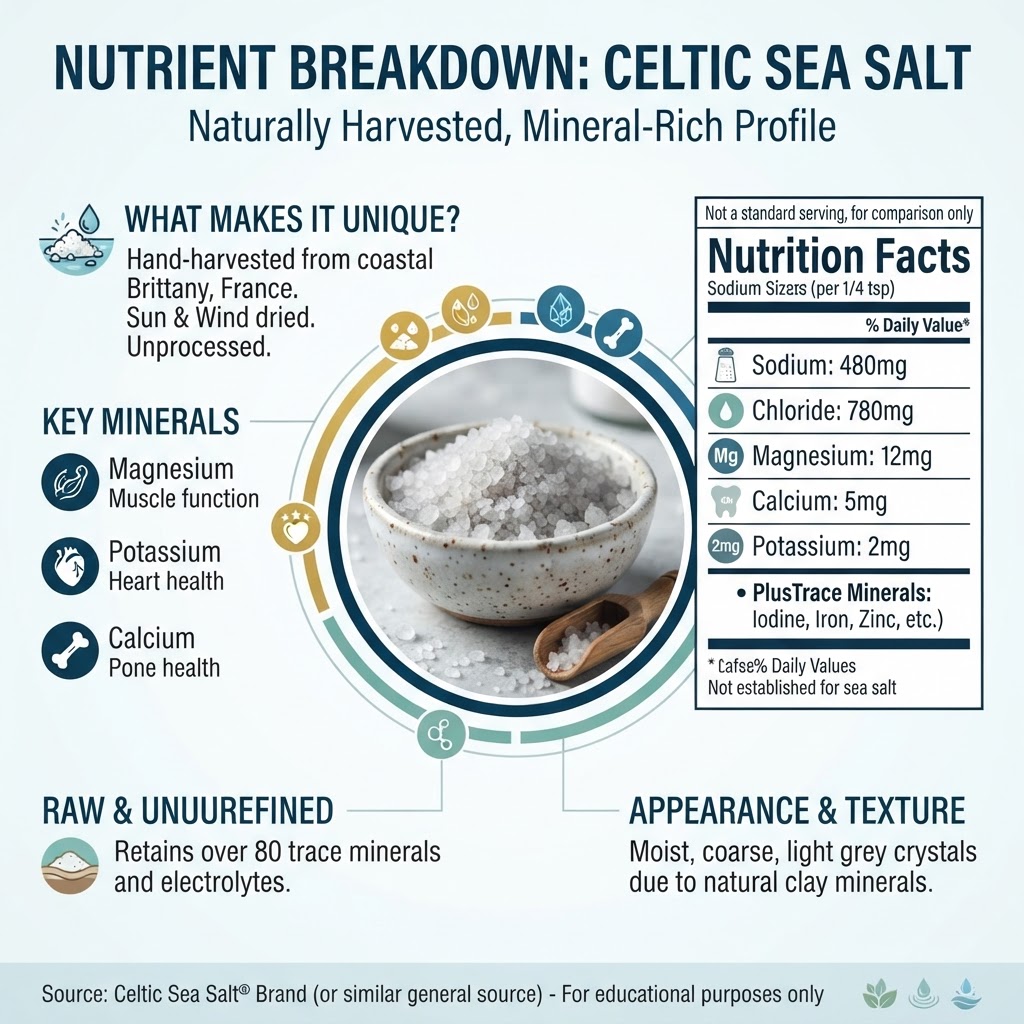
What Celtic grey salt does offer is an impressive array of trace minerals that work synergistically with thyroid function and overall health. Magnesium, present in meaningful quantities in authentic Celtic salt due to its clay mineral content, plays a role in converting T4 to the more active T3 form. Selenium, though present in small amounts in sea-harvested salts, is another trace mineral critical to thyroid hormone metabolism — it is a component of the enzymes that convert thyroid hormones into their active forms. Zinc similarly supports thyroid function, and Celtic grey salt contains trace amounts of this mineral as well. The broader mineral matrix of Celtic salt thus provides supportive micronutrients even if it does not serve as a primary iodine source.
For individuals who choose to use Celtic grey salt as their primary culinary salt — a choice driven by its exceptional flavour, mineral complexity, and clean ingredient profile — it is entirely possible to maintain excellent iodine status through thoughtful dietary planning. The richest dietary sources of iodine include ocean fish and shellfish, particularly cod, tuna, shrimp, and oysters. Seaweed and sea vegetables such as nori, kombu, wakame, and dulse are exceptionally concentrated sources of iodine, with some varieties containing hundreds of times the daily requirement per serving (which also necessitates caution with portion sizes). Dairy products including milk, yoghurt, and cheese provide meaningful iodine, partly because iodine-based sanitising solutions are commonly used in dairy farming and processing equipment. Eggs, particularly the yolk, contain iodine as well. Someone who regularly eats any combination of these foods is unlikely to experience iodine deficiency simply by switching from iodised table salt to natural Celtic grey salt.
It is also worth considering the broader sodium context. Health authorities in most countries recommend limiting total sodium intake to around 2,000 to 2,300 milligrams per day — roughly equivalent to 5 to 6 grams of salt. If a person were relying entirely on iodised table salt as their iodine source and consuming the recommended sodium limits, they would only be getting a portion of their daily iodine requirement from salt anyway. The implication is clear: a well-rounded diet rich in iodine-containing whole foods is the proper foundation for thyroid health, and the type of salt used at the table, while meaningful, is only one piece of a much larger nutritional picture. You can explore more about the mineral content of Celtic salt and what makes Guérande grey salt unique in our dedicated guide.
Health and Culinary Benefits
Beyond the iodine conversation, Celtic grey salt from Guérande offers a remarkable profile of benefits that have made it a preferred choice among chefs, nutritional therapists, and health-conscious households across Europe and increasingly worldwide. It is important to note upfront that while we can discuss the nutritional characteristics and culinary properties of Celtic salt with confidence, it would be inappropriate to make specific medical claims. What we can do is present the evidence-based attributes of this exceptional natural product and allow readers to draw informed conclusions.
From a nutritional standpoint, the most significant distinction between Celtic grey salt and standard refined table salt is the mineral complexity. Standard table salt is typically 99.9% sodium chloride, with added iodine and anti-caking agents, and virtually all naturally occurring trace minerals removed during processing. Celtic grey salt, by contrast, contains approximately 84% sodium chloride, with the remaining 16% comprising moisture and a diverse array of minerals including magnesium chloride, magnesium sulphate, calcium chloride, potassium chloride, and dozens of additional trace elements naturally present in Atlantic seawater and the grey clay of the Guérande salt pans. This lower sodium chloride percentage means that Celtic salt provides less sodium per gram than refined table salt — a point that may be relevant for individuals monitoring their sodium intake.
Magnesium deserves special attention here. Modern Western diets are widely considered to be deficient in magnesium, with studies suggesting that a substantial proportion of the population fails to meet recommended intakes. Magnesium is involved in over 300 enzymatic reactions in the human body, including those related to energy production, muscle function, nerve transmission, blood sugar regulation, and — critically for this discussion — thyroid hormone conversion. The magnesium in Celtic grey salt is naturally chelated with chloride in a form that is readily bioavailable, meaning the body can absorb and utilise it effectively. While the quantities contributed by salt are not enormous, they represent a consistent daily contribution from a source that most people use multiple times each day.
Culinary professionals have long celebrated Celtic grey salt for its distinctive flavour profile, which is often described as briny, complex, slightly mineral, and with a subtle sweetness that is entirely absent from refined table salt. The moisture content of authentic Guérande grey salt — a characteristic that lesser processed salt imitators often lack — contributes to its distinctive clumping texture and the way it dissolves slowly and unevenly, creating what chefs describe as flavour bursts. This complex flavour means that cooks often use less Celtic salt than they would refined salt to achieve the same level of seasoning satisfaction, which may contribute to lower overall sodium consumption. The fleur de sel — the delicate flower of salt hand-skimmed from the surface of the Guérande pans — is considered among the finest finishing salts in the world, prized in Michelin-starred kitchens across Europe.
From a digestive perspective, some practitioners of integrative nutrition suggest that the broader mineral profile of unprocessed natural salts may support stomach acid production and overall digestive function more effectively than pure sodium chloride. Adequate stomach acid (hydrochloric acid) requires chloride as a precursor, and the complex mineral chlorides present in Celtic salt contribute to this process in a whole-food context. Additionally, the absence of chemical anti-caking agents — substances like sodium aluminosilicate or ferrocyanides that are commonly added to table salt — means that Celtic salt represents a cleaner, more natural product from an ingredient transparency standpoint. For anyone seeking to reduce their exposure to unnecessary food additives, this distinction is meaningful. Learn more about how Celtic salt compares to table salt across health and culinary dimensions in our comprehensive comparison article.
How to Use Celtic Salt and Thyroid Health Principles — Expert Tips
Integrating Celtic grey salt into a thyroid-supportive lifestyle requires a combination of understanding what Celtic salt does well, what iodine sources to incorporate from elsewhere in the diet, and how to use this exceptional ingredient to its fullest culinary potential. The following expert guidance draws on the principles of both functional nutrition and professional culinary practice.